nuc.setupBEExp

nucleardatapy.nuc.setup_be_exp.be_exp_tables()[source]

Return a list of the tables available in this toolkit for the experimental masses and print them all on the prompt. These tables are the following ones: ‘AME’.

Returns:

The list of tables.

Return type:

list[str].

nucleardatapy.nuc.setup_be_exp.be_exp_versions(table)[source]

Return a list of versions of tables available in this toolkit for a given model and print them all on the prompt.

Parameters:

table (str.) – The table for which there are different versions.

Returns:

The list of versions. If table == ‘AME’: ‘2020’, ‘2016’, ‘2012’.

Return type:

list[str].

class nucleardatapy.nuc.setup_be_exp.setupBEExp(table='AME', version='2020')[source]

Instantiate the experimental nuclear masses from AME mass table.

This choice is defined in the variables table and version.

table can chosen among the following ones: ‘AME’.

version can be chosen among the following choices: ‘2020’, ‘2016’, ‘2012’.

Parameters:
  • table (str, optional.) – Fix the name of table. Default value: ‘AME’.

  • version (str, optional.) – Fix the name of version. Default value: 2020’.

Attributes:

D3n(Zref=50)[source]

Compute the three-points odd-even mass staggering (D3p_n) D3n(Z,N) = (-)**N * ( 2*E(Z,N)-E(Z,N+1)-E(Z,N-1) ) / 2

D3p(Nref=50)[source]

Compute the three-points odd-even mass staggering (D3p_n) D3p(Z,N) = (-)**Z * ( 2*E(Z,N)-E(Z+1,N)-E(Z-1,N) ) / 2

S2n(Zref=50)[source]

Compute the two-neutron separation energy (S2n) S2n(Zref,N) = E(Zref,N)-E(Zref,N-2)

S2p(Nref=50)[source]

Compute the two-proton separation energy (S2p) S2p(Z,Nref) = E(Z,Nref)-E(Z-2,Nref)

Zmax

maximum charge of nuclei present in the table.

Type:

Attribute Zmax

dist_nbNuc

attribute number of nuclei discovered per year

dist_year

attribute distribution of years

flagI

Attribute I.

flagInterp

Attribute Interp (interpolation). Interp=’y’ is the nucleushas not been measured but is in the table based on interpolation expressions.otherwise Interp = ‘n’ for nuclei produced in laboratory and measured.

isotones(Nref=50)[source]

Method which find the first and last isotones for N=Nref.

Parameters:

Nref (int, optional. Default: 50.) – Fix the neutron number for the search of isotones.

Attributes:

isotopes(Zref=50)[source]

Method which find the first and last isotopes for Z=Zref.

Parameters:

Zref (int, optional. Default: 50.) – Fix the charge for the search of isotopes.

Attributes:

label

Attribute providing the label the data is references for figures.

nbLine

Attribute with the number of line in the file.

nbNuc

Attribute with the number of nuclei read in the file.

note

Attribute providing additional notes about the data.

nucA

Attribute A (mass of the nucleus).

nucBE

Attribute BE (Binding Energy) of the nucleus.

nucBE_err

Attribute uncertainty in the BE (Binding Energy) of the nucleus.

nucHT

Attribute HT (half-Time) of the nucleus.

nucI

Attribute I (isospin asymmetry):

nucN

Attribute N (number of neutrons of the nucleus).

nucStbl

Attribute stbl. stbl=’y’ if the nucleus is stable (according to the table). Otherwise stbl = ‘n’.

nucSymb

Attribute symb (symbol) of the element, e.g., Fe.

nucYear

Attribute year of the discovery of the nucleus.

nucZ

Attribute Z (charge of the nucleus).

print_outputs()[source]

Method which print outputs on terminal’s screen.

ref

Attribute providing the full reference to the paper to be citted.

select(Amin=0, Zmin=0, interp='n', state='gs', nucleus='unstable', every=1)[source]

Method which select some nuclei from the table according to some criteria.

Parameters:
  • interp (str, optional. Default = 'n'.) – If interp=’n’, exclude the interpolated nuclei from the selected ones. If interp=’y’ consider them in the table, in addition to the others.

  • state (str, optional. Default 'gs'.) – select the kind of state. If state=’gs’, select nuclei measured in their ground state.

  • nucleus (str, optional. Default 'unstable'. It can be set to 'stable', 'longlive' (with LT>10 min), 'shortlive' (with 10min>LT>1 ns), 'veryshortlive' (with LT< 1ns)) – ‘unstable’.

  • every (int, optional. Default every = 1.) – consider only 1 out of every nuclei in the table.

Attributes:

select_year(year_min=1940, year_max=1960, state='gs')[source]

Method which select some nuclei from the table according to the discovery year.

Parameters:
  • year_min

  • year_max

  • state (str, optional. Default 'gs'.) – select the kind of state. If state=’gs’, select nuclei measured in their ground state.

Attributes:

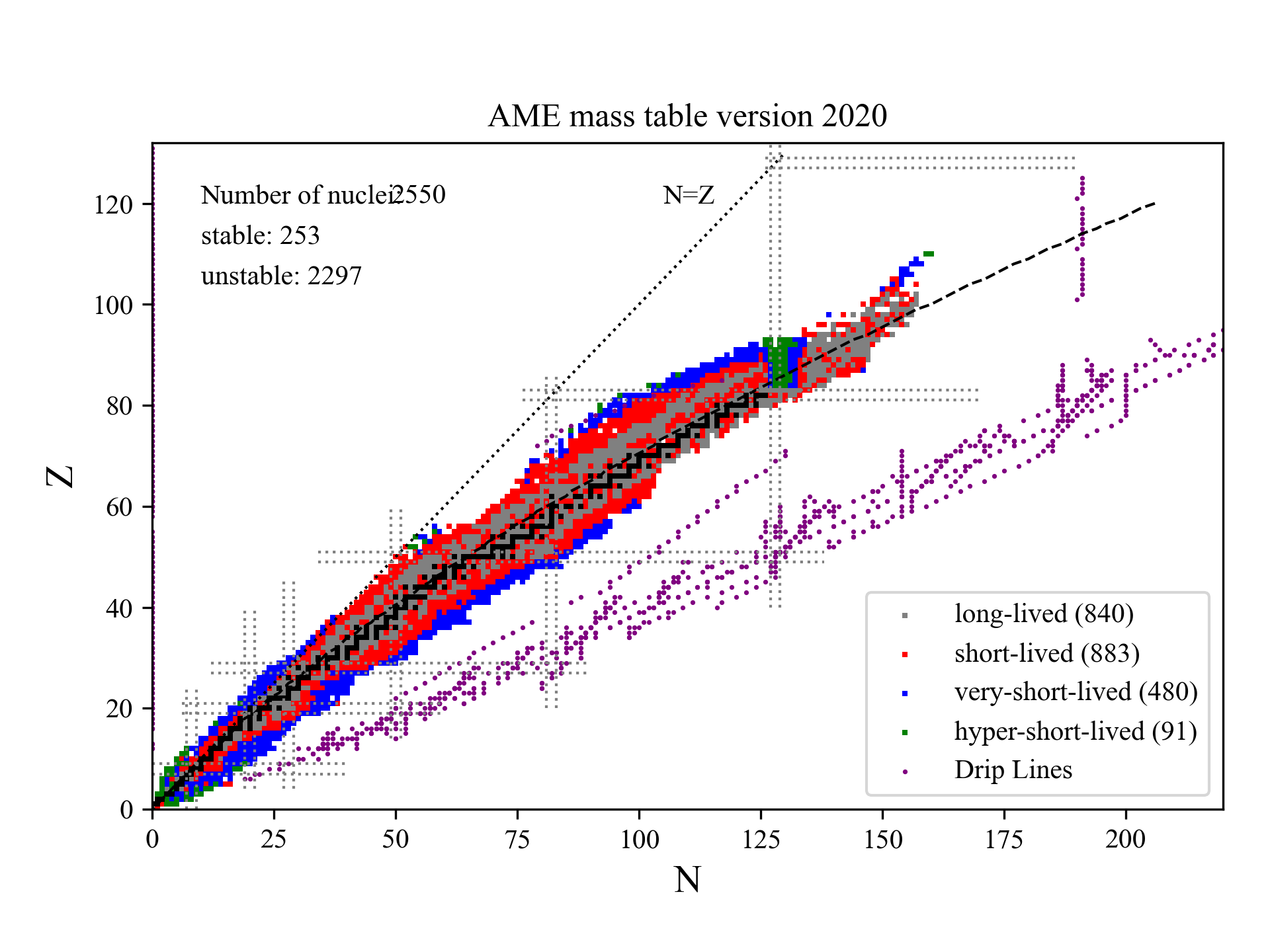
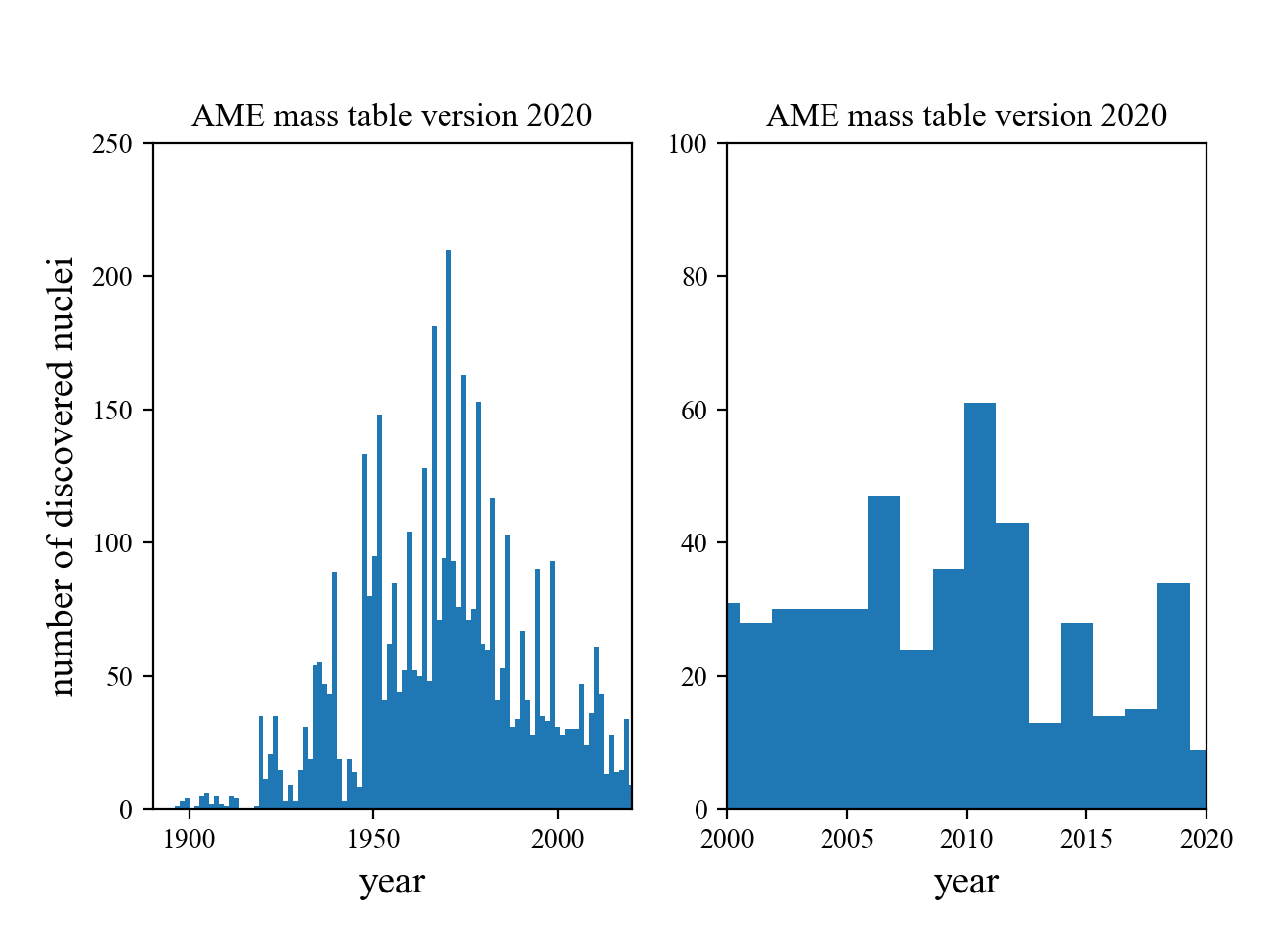
Here are a set of figures which are produced with the Python sample: /nucleardatapy_sample/nuc_setupBEExp_plot.py
map to buried treasure

The nuclear chart based on AME 2020 table. The different colors correspond to the different measured half-times of nuclei.
map to buried treasure

Histogram showing the distribution of nuclei per discovery year, since the first one discovered in 1897.