matter.setupPhenoEsym

nucleardatapy.matter.setup_pheno_esym.pheno_esym_models()[source]

Return a list of models available in this toolkit and print them all on the prompt.

Returns:

The list of models with can be ‘Skyrme’, ‘ESkyrme’, ‘NLRH’, ‘DDRH’, ‘DDRHF’.

Return type:

list[str].

nucleardatapy.matter.setup_pheno_esym.pheno_esym_params(model)[source]

Return a list with the parameterizations available in this toolkit for a given model and print them all on the prompt.

Parameters:

model (str.) – The type of model for which there are parametrizations. They should be chosen among the following options: ‘Skyrme’, ‘NLRH’, ‘DDRH’, ‘DDRHF’.

Returns:

The list of parametrizations. If models == ‘skyrme’: ‘BSK14’, ‘BSK16’, ‘BSK17’, ‘BSK27’, ‘F-’, ‘F+’, ‘F0’, ‘FPL’, ‘LNS’, ‘LNS1’, ‘LNS5’, ‘NRAPR’, ‘RATP’, ‘SAMI’, ‘SGII’, ‘SIII’, ‘SKGSIGMA’, ‘SKI2’, ‘SKI4’, ‘SKMP’, ‘SKMS’, ‘SKO’, ‘SKOP’, ‘SKP’, ‘SKRSIGMA’, ‘SKX’, ‘Skz2’, ‘SLY4’, ‘SLY5’, ‘SLY230A’, ‘SLY230B’, ‘SV’, ‘T6’, ‘T44’, ‘UNEDF0’, ‘UNEDF1’. If models == ‘ESkyrme’: ‘BSk22’, ‘BSk24’, ‘BSk25’, ‘BSk26’, ‘BSk31’, ‘BSk32’, ‘BSkG1’, ‘BSkG2’, ‘BSkG3’. If models == ‘NLRH’: ‘NL-SH’, ‘NL3’, ‘NL3II’, ‘PK1’, ‘PK1R’, ‘TM1’. If models == ‘DDRH’: ‘DDME1’, ‘DDME2’, ‘DDMEd’, ‘PKDD’, ‘TW99’. If models == ‘DDRHF’: ‘PKA1’, ‘PKO1’, ‘PKO2’, ‘PKO3’.

Return type:

list[str].

class nucleardatapy.matter.setup_pheno_esym.setupPhenoEsym(model='Skyrme', param='SLY5')[source]

Instantiate the object with results based on phenomenological interactions and choosen by the toolkit practitioner. This choice is defined in the variables model and param.

If models == ‘Skyrme’, param can be: ‘BSK14’, ‘BSK16’, ‘BSK17’, ‘BSK27’, ‘BSkG1’, ‘BSkG2’,’F-’, ‘F+’, ‘F0’, ‘FPL’, ‘LNS’, ‘LNS1’, ‘LNS5’, ‘NRAPR’, ‘RATP’, ‘SAMI’, ‘SGII’, ‘SIII’, ‘SKGSIGMA’, ‘SKI2’, ‘SKI4’, ‘SKMP’, ‘SKMS’, ‘SKO’, ‘SKOP’, ‘SKP’, ‘SKRSIGMA’, ‘SKX’, ‘Skz2’, ‘SLY4’, ‘SLY5’, ‘SLY230A’, ‘SLY230B’, ‘SV’, ‘T6’, ‘T44’, ‘UNEDF0’, ‘UNEDF1’.

If models == ‘ESkyrme’, param can be: ‘BSk22’, ‘BSk24’, ‘BSk25’, ‘BSk26’, ‘BSk31’, ‘BSk32’, ‘BSkG3’,’BSkG4’ .

If models == ‘Fayans’, param can be: ‘Fy(IVP)’, ‘Fy(Dr,HDB)’, ‘Fy(std)’ If models == ‘Gogny’, param can be: ‘D1S’, ‘D1’, ‘D250’, ‘D260’, ‘D280’, ‘D300’ If models == ‘NLRH’, param can be: ‘NL-SH’, ‘NL3’, ‘NL3II’, ‘PK1’, ‘PK1R’, ‘TM1’.

If models == ‘DDRH’, param can be: ‘DDME1’, ‘DDME2’, ‘DDMEd’, ‘PKDD’, ‘TW99’.

If models == ‘DDRHF’, param can be: ‘PKA1’, ‘PKO1’, ‘PKO2’, ‘PKO3’.

Parameters:
  • model (str, optional.) – Fix the name of model: ‘Skyrme’, ‘NLRH’, ‘DDRH’, ‘DDRHF’. Default value: ‘Skyrme’.

  • param (str, optional.) – Fix the parameterization associated to model. Default value: ‘SLY5’.

Attributes:

Parameters:
  • model (str, optional)

  • between (The model to consider. Choose)

  • var2 (var1 and)

  • np.array([0.1 (var1 =)

  • 0.15

  • 0.16

  • 0.17

  • 0.2

  • 0.25])

init_self()[source]

Initialize variables in self.

model

Attribute model.

param

Attribute param.

print_outputs()[source]

Method which print outputs on terminal’s screen.

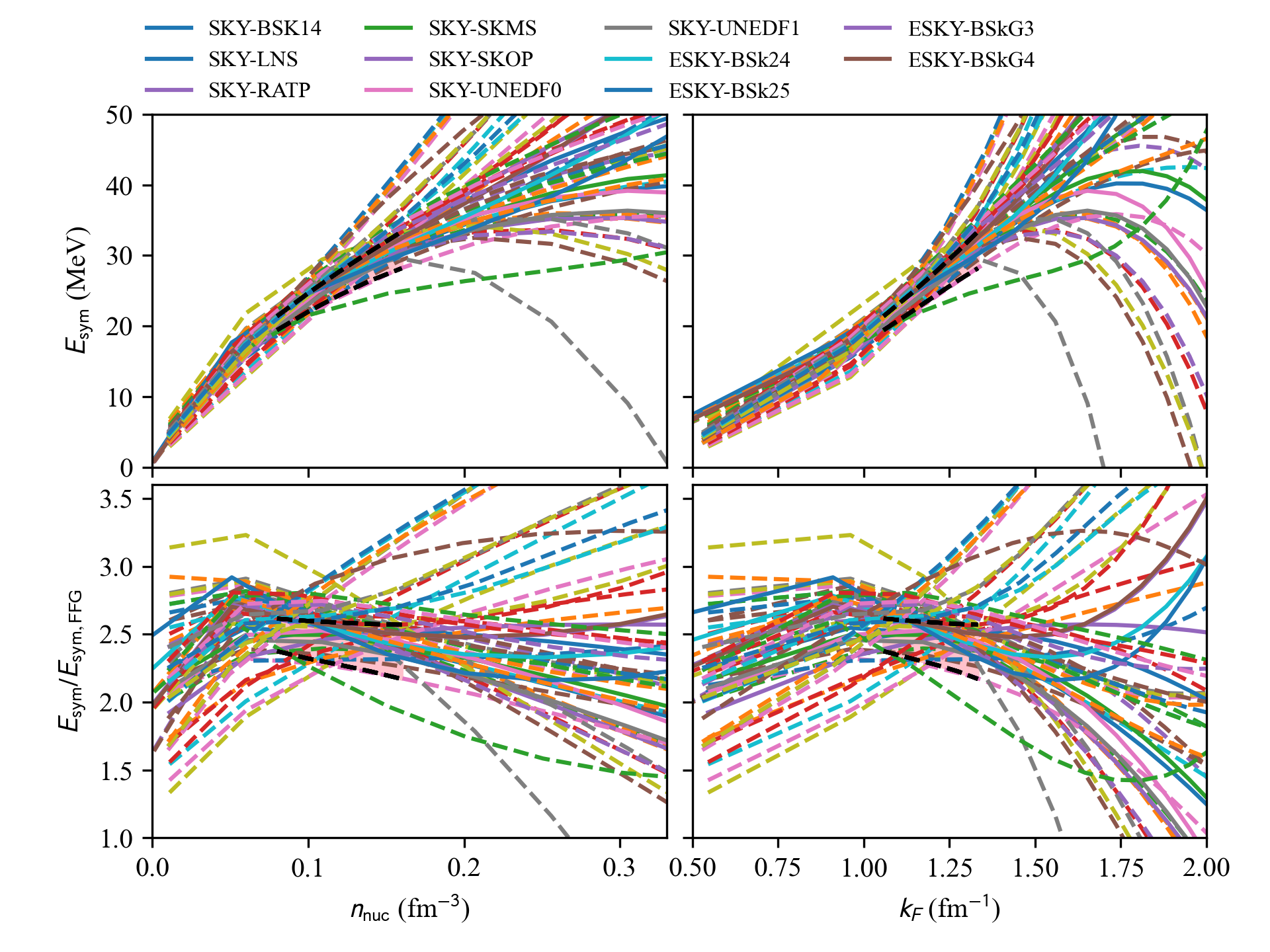
Here are a set of figures which are produced with the Python sample: /nucleardatapy_sample/matter_setupPhenoEsym_plot.py
map to buried treasure

This figure shows the symmetry energy as function of the density (left) and the neutron Fermi momentum (right) for the models available in the nucleardatapy toolkit.